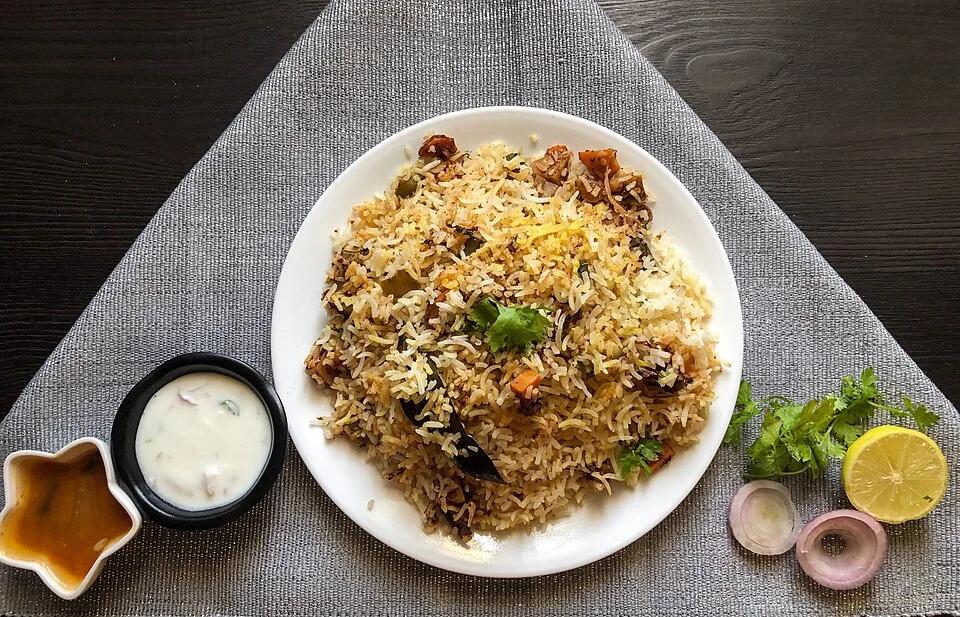
Ask someone from Andhra Pradesh or Telangana what they miss most about home food, and the answer is often a rice dish. Not biryani, but the everyday flavoured rice: tamarind rice packed for a train journey, gongura rice on a Sunday, a bowl of something sour and spicy with curd on the side.
Our Andhra rice menu is the longest section in our kitchen, and the part we're proudest of. Here's what each dish is, how hot it is, and what to eat with it.
A quick word on how these work
Most of these rices follow the same idea. Rice is cooked, then mixed with a flavouring (tamarind, a leaf, a vegetable, a spice powder) and finished with a tadka or popu: mustard seeds, chana dal and urad dal, dried red chillies, curry leaves and often peanuts, crackled in hot oil. The dals turn golden and crunchy, the curry leaves crisp up, and that tempering is what gives these rices their texture and smell.
A couple of them are pulaos instead, where the rice is cooked in the flavour from the start.
The sour ones
Pulihora (tamarind rice)
Pulihora is the dish most Telugu people think of first. Rice is mixed with a thick tamarind paste, turmeric and hing, then tossed with the tempering and plenty of peanuts. It's sour, nutty and moderately spicy, and it's one of those dishes that tastes good warm or at room temperature, which is why it's served at festivals, temples and on every long journey.
Spice: medium. Eat it with: plain curd, Andhra egg curry, or a crisp gobi 65.
Mamidikaya pulihora (raw mango rice)
Mamidikaya pulihora swaps tamarind for grated raw mango. The sourness is brighter and sharper, more like a squeeze of lime than tamarind's deep tang. It's a seasonal special, so it appears when good raw mangoes are around.
Spice: medium. Eat it with: curd, or alongside a curry.
Gongura rice
If one flavour says "Andhra" more than any other, it's gongura. These are sorrel leaves (also called roselle or red sorrel), and they're intensely sour. For gongura rice, the leaves are cooked down with green and red chillies and garlic until they collapse into a dark paste, then mixed into rice and tempered.
It's sharp, sour and hot, and people who grew up with it tend to order it every time.
Spice: hot. Eat it with: curd or buttermilk, without question. Andhra chicken curry if you want a full meal.
Tomato rice
Tomato rice is the gentle cousin of the sour rices: ripe tomatoes cooked down with onion, green chilli and ginger-garlic, then mixed with rice and tempered with mustard seeds and curry leaves. It's tangy and comforting, and a good starting point if you're new to these dishes.
Spice: medium. Eat it with: curd, chicken 65 or Andhra egg curry.
The pulaos
Ulavacharu pulao
Ulavacharu is a thick, dark soup made by slow-cooking horse gram (ulavalu), a small, earthy lentil. In Andhra, it's eaten with rice and a spoon of cream or ghee, and in recent years it's become a favourite restaurant flavour in Hyderabad too. Horse gram is traditionally thought of as a warming, winter food.
For ulavacharu pulao, basmati rice is cooked with ulavacharu, onion, green chilli, curry leaves and whole spices. The result is earthy, tangy and quite unlike anything else on the menu.
Spice: medium. Eat it with: plain curd, paneer pepper fry or chicken 65.
Pachimirchi pulao
Pachimirchi means green chilli, and pachimirchi pulao doesn't hide it. Basmati rice is cooked with a coarse paste of green chilli, ginger, garlic and mint, plus whole spices and onion. It's fragrant and fresh-tasting, and properly hot.
Spice: hot. Eat it with: curd or mixed raita. Order a paneer ghee roast alongside if you want to go all in.
The herb and leaf rices
Karivepaku annam (curry leaf rice)
Karivepaku annam uses curry leaves as the main flavour, not just a garnish. The leaves are roasted with chana dal, urad dal, dried red chillies, pepper and cumin, ground into a powder, then tossed through rice with a peanut tempering. It's aromatic, earthy and a little nutty.
Spice: medium. Eat it with: curd or paneer pepper fry.
Kothimeera rice (coriander rice)
Kothimeera rice is fresher and greener: rice mixed with a paste of fresh coriander, green chilli and ginger, tempered with mustard seeds, cumin and curry leaves. It's one of the milder options and goes well with spicier curries.
Spice: mild. Eat it with: Andhra chicken curry or paneer pepper fry.
Coconut rice
Coconut rice is the mildest of all. Freshly grated coconut is tossed through rice with a tempering of mustard, dals, green chilli and curry leaves. It's fragrant and lightly sweet, and it's the one to give anyone who isn't used to heat. If you have a nut allergy, tell us when you order.
Spice: mild. Eat it with: Andhra chicken curry or Andhra chilli chicken, where it balances the fire.
The southern visitor: vangi bath
Vangi bath (brinjal rice) is originally from Karnataka, but it's loved across the South. Brinjal is cooked with a roasted spice powder of coriander seed, dals, red chilli, cinnamon and coconut, then mixed with rice. It's a seasonal special on our menu.
Spice: medium. Eat it with: curd.
Spice at a glance
- Mild: coconut rice, kothimeera rice
- Medium: pulihora, mamidikaya pulihora, tomato rice, ulavacharu pulao, karivepaku annam, vangi bath
- Hot: gongura rice, pachimirchi pulao
Why these are great for groups
Almost all of these rices are vegetarian, they travel well, and they're as good at room temperature as they are hot. That makes them ideal for a team lunch: order two or three different rices, a bowl of curd, a fried starter like gobi 65 or chicken 65, and buttermilk all round. It's a very Telugu way to eat, and it usually costs less per head than a curry-and-bread spread.
Ordering
Seasonal dishes like mamidikaya pulihora and vangi bath change, so check the live menu to see what's on today. You can order direct for delivery or takeaway from our kitchen opposite Wipro in Gopanpally, every day from 11 am to 11:30 pm, with 20% off on our own site.